|
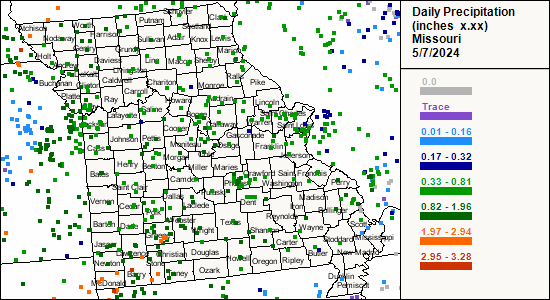
1) Important: If you need to enter precipitation accumulated over a multi-day period, please use the Multi-Day Accumulation report option that is available on your account.
2) We do not carry hail pads and were unable to find a local vendor with less expensive versions. These can be ordered through CoCoRaHS for $4.75 at the following link:
https://weatheryourway.com/collections/other-weather-observer-supplies
Or, you can make your own hail pad:
http://www.cocorahs.org/Content.aspx?page=MakingHailPads
If you have a hail pad, be sure to mark the location of where the pad is placed ex, 3 miles south east of "city". Be sure to mark your station ID on the hail pad report which can be found on the CoCoRaHS website! Always remember to anchor your hail pad, the last thing you want is your valuable hail information being carried away in the wind.
3) Your state Leadership:
*****************************************************
 | Missouri State Coordinator
|
Anthony Lupo
Department of Soil, Environmental, and Atmospheric Science
302 E ABNR Building
University of Missouri – Columbia
Columbia, MO 65211
573-884-1638
573-884-5070
lupoa@missouri.edu |
Missouri CoCoRaHS Regions
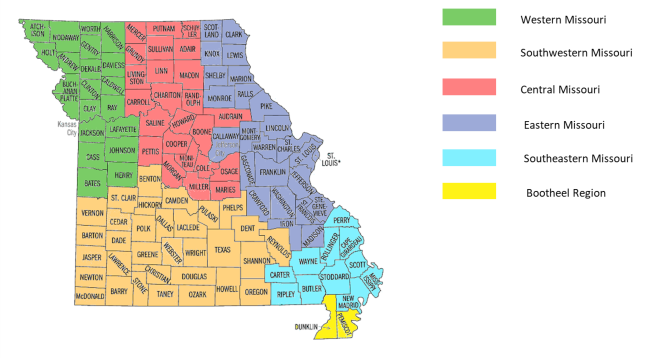
MISSOURI REGIONAL COORDINATORS
Western Region Coordinator
Brett Williams
Kansas City/Pleasant Hill, MO
1803 North 7 Highway
Pleasant Hill, MO 64080-9421
816-540-5147
brett.williams@noaa.gov
Andrew
Atchison
Bates
Buchanan
Caldwell
Cass
Clay
Clinton
Daviess
DeKalb
Gentry
Harrison
Henry
Holt
Jackson
Johnson
Lafayette
Nodaway
Platte
Ray
Worth
Southwestern Missouri Region Coordinators
Nicolette Zangara
Meteorologist
Springfield, MO
Trevor Grout
NWS Springfield, Missouri
Springfield-Branson Regional Airport
5805 West Highway EE
Springfield, MO 65802-8430
417-864-8535
trevor.grout@noaa.gov
Barry
Barton
Benton
Camden
Cedar
Christian
Dade
Dallas
Dent
Douglas
Greene
Hickory
Howell
Jasper
Laclede
Lawrence
McDonald
Newton
Oregon
Ozark
Phelps
Polk
Pulaski
Reynolds
Shannon
St. Clair
Stone
Taney
Texas
Vernon
Webster
Wright
Central Missouri Region Coordinator
Anthony Lupo
Department of Soil, Environmental, and Atmospheric Science
302 E ABNR Building
University of Missouri – Columbia
Columbia, MO 65211
573-884-1638
573-884-5070 lupoa@missouri.edu
Assistant Coordinator
Travis Bradshaw (MO-BN-31)
email: midwayweather@gmail.com
Adair County
Audrain County
Boone County
Callaway County
Carroll County
Chariton County
Cole County
Cooper County
Grundy County
Howard County
Linn County
Livingston County
Macon County
Maries County
Mercer County
Miller County
Moniteau County
Morgan County
Osage County
Pettis County
Putnam County
Randolph County
Saline County
Schuyler County
Sullivan County
Eastern Missouri Region Coordinator
Patrick Walsh
National Weather Service
STL - Weather Forecast Office
12 Missouri Research Park Drive
Saint Louis, MO 63304
636-441-8467
patrick.walsh@noaa.gov
Clark
Crawford
Franklin
Gasconade
Iron
Jefferson
Knox
Lewis
Lincoln
Madison
Marion
Monroe
Montgomery
Pike
Ralls
Scotland
Shelby
St. Charles
St. Francois
St. Louis (City)
St. Louis
Ste. Genevieve
Warren
Washington
Southeastern Missouri Region Coordinator
Sean Poulos
Paducah, KY Weather Forecast Office
8250 Kentucky Highway 3520
West Paducah, KY 42086-9762
270-744-6440 x675
Sean.Poulos@noaa.gov
Bollinger
Butler
Cape Girardeau
Carter
Mississippi
New Madrid
Perry
Ripley
Scott
Stoddard
Wayne
Bootheel Region Coordinators Desiree Meadows, Kati McNeil
National Weather Service Memphis, Tennessee
7777 Walnut Grove Road, Suite 1
Memphis, TN 38120
901-544-0399
desiree.meadows@noaa.gov
kati.mcneil@noaa.gov
Dunklin
Pemiscot
|