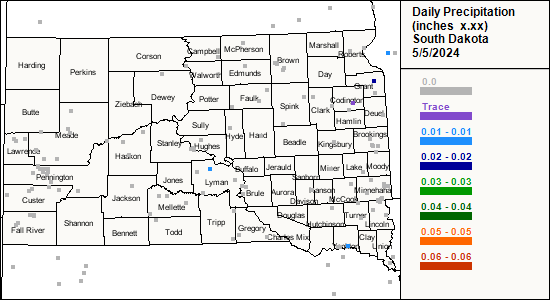
South Dakota
  Union Clay Yankton Bon Homme Lincoln Turner Hutchinson Minnehaha McCook Hanson Davison Moody Lake Miner Sanborn Douglas Charles Mix Aurora Brule Jerauld Buffalo Gregory Tripp Lyman Todd Mellette Jones Bennett Jackson Shannon Fall River Custer Brookings Kingsbury Beadle Hand Hyde Hughes Sully Stanley Haakon Pennington Deuel Grant Hamlin Codington Clark Spink Faulk Potter Dewey Ziebach Meade Lawrence Butte Walworth Edmunds Day Roberts Marshall Brown McPherson Campbell Corson Perkins Harding

View Large Map


Welcome to the South Dakota CoCoRaHS Page


Snow Measuring Reminders...It's that time of year again!

With winter upon us, it’s time once again to review the procedures for measuring and reporting winter precipitation.

Helpful reminders:

1.       At the beginning of the snowfall/freezing season, remove the funnel and inner measuring tube of the rain gauge to expose the overflow can so that is can more accurately catch frozen precipitation.

2.       Check your gauge to make sure there are no leaks. If there are leaks, give us a call and we’ll mail you out a new one.

3.       If you have a snow board, put it out and mark its location with a flag or some other indicator so it can be found after a new snowfall.  Be sure to locate it in an open area (not under trees, obstructions, or on the north side of structures in the shadows).


What to report:

1.       Measure and record the snowfall (snow, sleet, snow pellets) since the previous snowfall observation.  Take this measurement once-a-day and be sure to reflect the total accumulation of new snow observed (in inches and tenths, for example, 3.9 inches) since the last snowfall observation.

2.       Determine the depth of snow on the ground at the normal observation time. Take this observation once-a-day at the scheduled time of observation.  Use a measuring stick to measure the total depth of snow on the ground.  Report snow depth to the nearest whole inch, rounding up when one-half inch increments are reaches (example 0.4 inches gets reports as a trace (T), 3.5 inches gets reported as 4 inches).

3.       Measure and record the water equivalent of snowfall since the previous days observation.

Measuring liquid precipitation equivalent:

1.       Report the liquid water equivalent for any NEW snowfall to the nearest 0.01 inch.

a.       Two methods for melting snow

                                                              i.      Add  warm water to the gauge in order to melt the snow. Remember to carefully measure the added warm water so you can subtract that figure from your final measurement.

                                                            ii.      Another method is to place the rain gauge in a bucket of warm water. Remember to dry the outside of the gauge off so none of the water from the bucket runs down the sides and into your measuring tube.

2.       If too little snow has fallen to effectively measure, report it as a trace.

Reporting New Snowfall Depth:

1.       Take an average of ten measurements in an open area. Try to avoid any drifts or bare spots.

2.       Report to the nearest 0.1 of an inch.

Reporting Total Snow Depth:

1.       Report snow depth whenever snow covers more than 50% of the ground.

2.       Report to the nearest whole inch. If less than ½ inch, report as a trace.

Note: Measuring total snow depth can be tricky. As you know, snow may melt quickly from south facing areas, but linger for days in shaded or north facing area.  Use good judgement in averaging the snow depth around your area.

We at the National Weather Service would like to take this opportunity to say THANKS!  With the assistance of our COOP and precipitation spotters, we hope to have a successful winter season keeping the public informed and ready.


Who can join?
Anyone! The more people in the Cocorahs network the better! We are looking for accurate and consistent observations however. Summertime rain showers and thunderstorms produce highly variable precipitation amounts and forecasters, emergency management officials, water resource planners, and many others use your CoCoRaHS data on a daily basis. Even if you received no precipitation, we want to know. Sometimes reports of zero precipitation are as important as when precipitation occurs. Below is a map of the current number of Cocorahs observers per county in South Dakota.

How do I join?
To become an observer, click on "Join CoCoRaHS" and complete the on-line application form or contact your regional coordinator. You will receive an e-mail with your CoCoRaHS ID and instructions. As soon as you have a username, password and a rain gauge, you many enter observations immediately!

What will I need?
You will need to purchase a standard 4-inch rain gauge to measure your precipitation. For the quality of the data to be consistent everyone must have the same rain gauge.
You can purchase a rain gauge from either of the following sites:

Is there training available?
Online training can be found at the following links:

For a Power point Presentation:

http://climate.sdstate.edu/downloads/CoCoRaHS_Training_4.5-sd.ppt

For a video Presentation:
mms://teach.sdstate.edu/media/extension%20training/todey%205-31-07.wmv

Who is my regional coordinator?
If you need assistance or have questions, feel free to contact the State, Regional, or County Coordinators. Below is a map showing the three regions in South Dakota.

T
he following are the state and regional coordinators respectively:

State Coordinator
Dennis Todey [dennis.todey@sdstate.edu]

Western Regional Coordinator
Mitchell Erickson [mitchell.erickson@noaa.gov]

Northeastern Regional Coordinator
Timothy Kearns [timothy.kearns@noaa.gov]

Southeastern Regional Coordinators
Mike Gillispie [michael.gillispie@noaa.gov]
Donald Morin [donald.morin@noaa.gov]

What else can I do?
If you note any unusual or extreme weather, feel free to mention the event in the remarks section of your daily observation. The National Weather Service offices always appreciate your reports of strong winds, hail, or tornados. The National Weather Service also appreciates your reports during or shortly after the event via a phone call to 605-225-0519.